

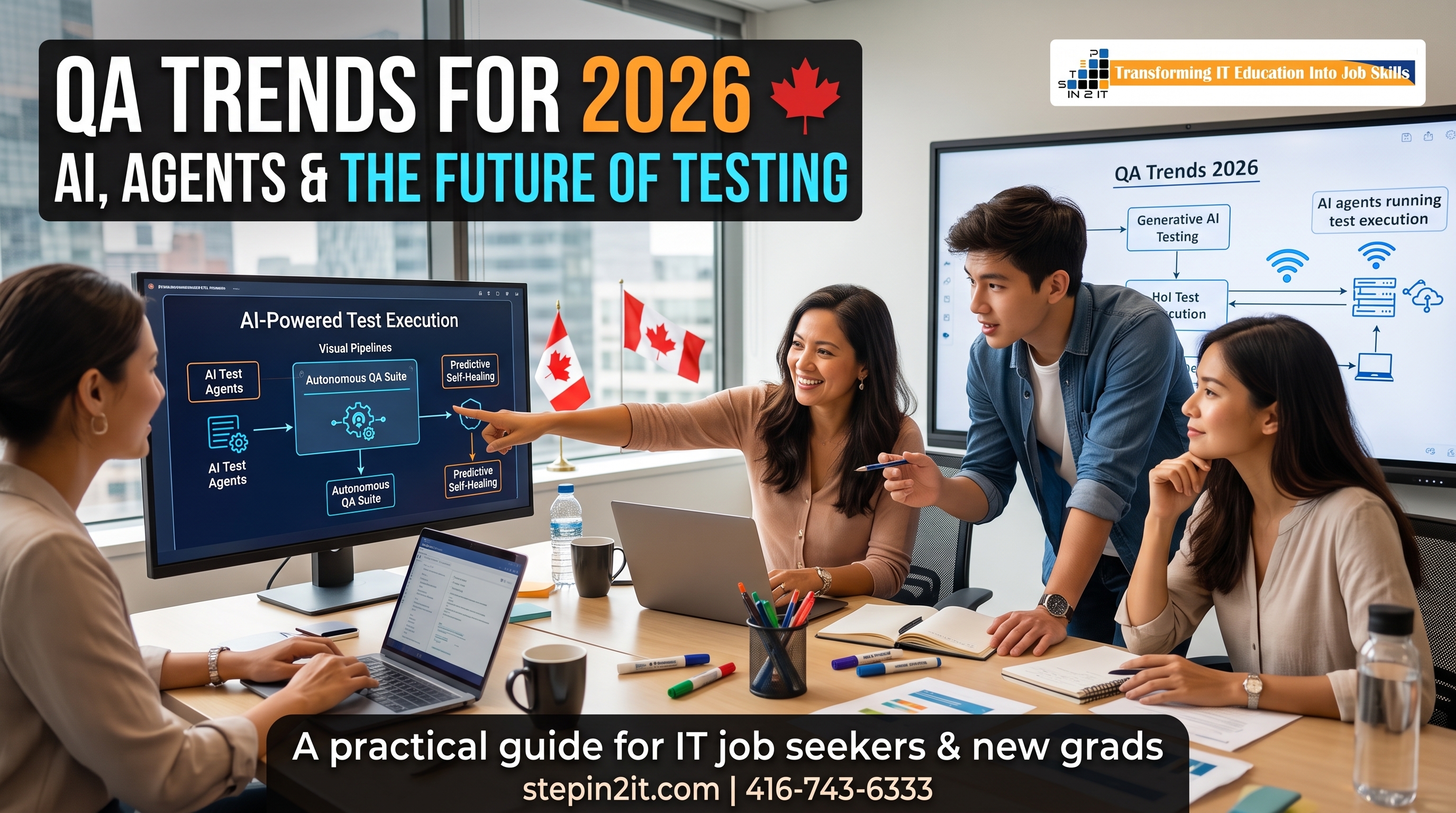
QA Trends 2026AI TestingAgentic AIFuture of QA
QA Trends for 2026: AI, Agents and the Future of Testing
AI can now write a test case in seconds. That doesn't make testers obsolete. It makes the testers who can judge that test case far more valuable.
That's the short version of where QA is heading in 2026. Here's the longer one, written for job seekers and new grads in Toronto and the GTA who want to know what's real, what's hype and what to learn next.
Both figures come from Tricentis's recap of its Transform 2025 conference, which cites a Stack Overflow survey. They're vendor-reported, so treat them as directional.
Six QA trends shaping 2026
1. More code, more to test
When AI helps write software faster, the volume of code needing checks goes up. Faster delivery doesn't remove the need for quality work. It increases it.
2. Agents join the team
An AI assistant suggests. An AI agent acts. Agentic tools can draft test cases from user stories or requirements and run them, with people reviewing the result.
3. Humans stay in the loop
AI output is probabilistic, meaning it can vary. Someone has to set quality goals, check results and decide what's good enough to ship.
4. Risk coverage beats test coverage
Chasing 100% coverage is a trap, especially with AI. Smart teams aim effort at what could hurt users and the business most.
5. Testing AI systems
Apps now contain models and chatbots. Testing them means checking data, bias, unpredictable answers and safety, not just buttons and forms.
6. Testers become orchestrators
Less time executing the same checks by hand. More time designing strategy, directing tools and explaining risk to the team.
What "agentic testing" actually means
Ignore the jargon for a second. An AI agent is software that can take steps toward a goal on its own: read a requirement, write tests, run them, look at the results and try again. A regular AI assistant waits for you to ask each question.
Sounds powerful, and it is. It also fails in ways that look confident. That's why the human reviewing the output matters. If you can spot a missing edge case, a wrong assumption or a test that passes for the wrong reason, you're the person the team can't replace.
Testing AI: a new specialty with its own certification
ISTQB, the body behind the Foundation certificate, now offers specialist paths for AI. Its AI Testing (CT-AI) syllabus version 2.0 focuses on testing AI-based systems and now covers generative AI and large language models. Its Testing with Generative AI (CT-GenAI) certification covers using generative AI in testing, including prompt engineering and risks. Both require the Foundation Level certificate first.
That makes ISTQB Foundation the sensible first step. Step In 2 IT is an accredited ISTQB training provider for CTFL in Canada.
Your 5-step plan to stay ahead
- Master the fundamentals first. You can't review an AI's test cases if you don't know what a good one looks like. Start with test design, test plans and defect reporting in our 39-hour Software Testing Program.
- Earn ISTQB Foundation. It gives you the shared vocabulary employers use and opens the door to AI-focused specialist certifications later.
- Learn automation. Agents build on automation ideas. Understanding how a script works helps you check one. Start with Selenium.
- Practice with AI tools, critically. Ask an AI to draft test cases for an app you know. Then find what it missed. Keep notes. That's portfolio material.
- Get good at risk. For every feature, ask what would hurt most if it broke, and test there first.
The skills that don't change
Curiosity. Clear writing. Asking "what if the user does something odd?" Explaining a problem so a busy developer understands it in thirty seconds. AI doesn't replace these. If anything, it makes them easier to see.
Frequently asked questions
What are the biggest QA trends for 2026?
AI-assisted and agentic testing, human oversight of AI output, risk-based test strategy, testing AI-based systems and the shift from executing tests to orchestrating quality.
Will AI replace QA testers in Canada?
AI is changing the work, not removing the need for judgment. Testers who can direct AI tools and check their output are in a stronger position than those who only run scripts. The Toronto-region outlook is limited, so build skills that stand out.
Do I need a QA automation course in Toronto to work with AI testing tools?
It helps. Automation fundamentals let you understand and review what AI-generated tests are doing. Start with manual testing basics, then add automation.
Is ISTQB certification training in Toronto still worth it in 2026?
Yes. Foundation Level remains the standard starting credential, and the AI-focused ISTQB certifications require it first.
Is there QA software testing training with job assistance in Toronto, Brampton or Mississauga?
Providers differ. Ask exactly what job assistance includes, and remember no one can guarantee a job. Contact us to ask what applies to our programs and which batch formats fit your area.
Can I learn software testing in the GTA with no experience?
Yes. Step In 2 IT is in North York and offers a Software Testing Program for beginners. Contact us for current batch dates and formats.
What is the difference between an AI assistant and an AI agent?
An assistant suggests and answers when asked. An agent can plan and take steps toward a goal on its own, which is why it needs guardrails and human review.
What should I learn first: AI testing or the basics?
The basics. Fundamentals and ISTQB Foundation first, then automation, then AI-specific skills.
Build skills that last
Tell us your background and we'll point you to the right starting program.
Call 416-743-6333 info@stepin2it.com Free demo session
1315 Lawrence Avenue East, Unit 519, North York, ON M3A 3R3
Sources: Tricentis, QA trends for 2026 (recap of Transform 2025); Capgemini, Sogeti and OpenText, World Quality Report 2025-26; ISTQB (CT-AI v2.0, CT-GenAI); Government of Canada Job Bank (NOC 22222 outlook).