

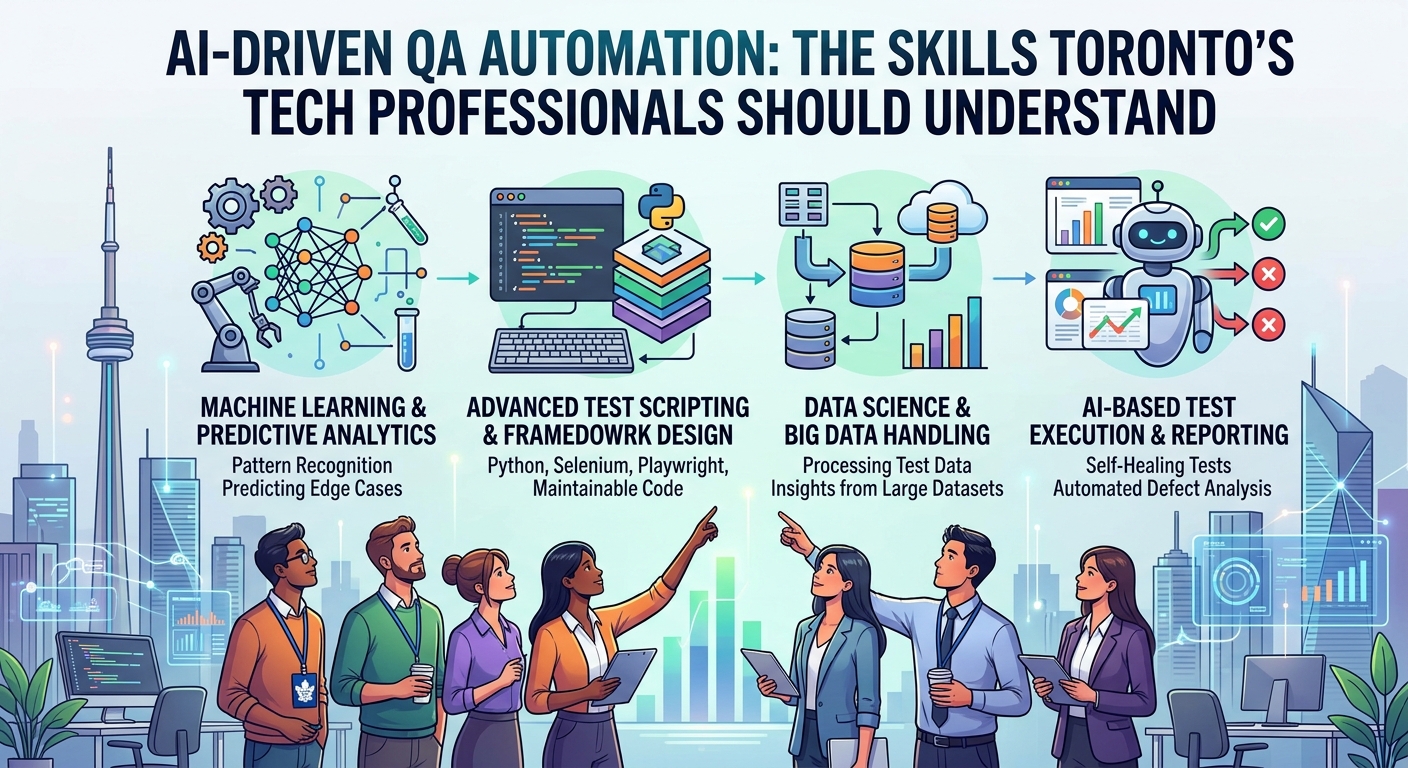
AI tools are changing how some testing tasks are approached. Learn what they can help with, where human judgement still matters, and how to build a practical QA skill set.
AI can help write a test script in seconds. Knowing whether that script tests the right thing is still the tester’s job.
Software testing is evolving as teams explore generative AI, coding assistants and more connected automation workflows. These tools may help testers draft code, explain errors, create test ideas or investigate failures. But they do not remove the need to understand requirements, assess risk, verify results and communicate defects clearly.
For people building a software testing career in Toronto and the Greater Toronto Area (GTA), AI-assisted QA is a useful area to understand alongside testing fundamentals and established automation tools. It is not accurate to assume every employer now requires AI-driven testing; check current job postings for the roles you want.
!
Important: AI-generated tests can be incomplete, incorrect or misleading. Review the logic, validate the expected result and never treat generated output as proof that an application is bug-free.
01 Five AI-related QA skills worth understanding
Use AI coding assistants thoughtfully
Tools such as ChatGPT and GitHub Copilot can help draft test code, explain unfamiliar syntax, suggest test cases or summarize an error. Treat the result as a starting point: inspect it, run it and confirm it checks the intended behaviour.
Understand browser automation
Playwright, Selenium and Cypress are tools used to automate browser-based checks. Learn the testing concepts behind them—selectors, assertions, waits, test data, debugging and maintainable test design—rather than collecting tool names without practice.
Evaluate “self-healing” claims carefully
Some automation products aim to recover from changes such as modified page elements. This may reduce certain maintenance tasks, but it can also hide a real change in behaviour if used carelessly. Review what changed and confirm that the test still checks the right thing.
Learn the basics of agentic workflows and MCP
Agentic workflows can let AI systems carry out multi-step tasks using approved tools. The Model Context Protocol (MCP) is an open standard for connecting AI applications with external tools and context. In a QA setting, such workflows could assist with selected tasks, but permissions, human review and clear safeguards remain important.
Test AI-powered features themselves
Applications that use AI can produce variable responses. Testing may need to consider accuracy, relevance, consistency, privacy, safety and how the system handles unexpected input—not only whether a button or page works.
02 A practical learning roadmap
You do not need to learn every AI tool at once. Build a strong foundation, then add automation and AI-assisted workflows in a sequence that fits your goals.
Build testing fundamentals
Practise requirements analysis, test scenarios, test cases, expected results, defect reports, regression testing and risk-based thinking.
Learn one automation path
Choose a tool such as Selenium or Playwright based on your current skills and the job postings you are targeting. Learn enough programming to read, write and debug tests.
Use AI on a small, safe task
Ask an assistant to suggest edge cases or explain a test failure. Check its suggestions against the requirements and avoid sharing confidential employer, customer or production data with unapproved tools.
Document your decisions
Build a small portfolio project. Explain what each test checks, why the scenario matters, how you validated the output and what you learned from failures.
CAREER TIP · TORONTO & GTA
Let real job postings shape your plan
Review current QA and automation vacancies in Toronto and nearby communities. Note recurring requirements across several relevant postings, then prioritize those skills. Tool demand varies by employer, product and seniority.
03 What to look for in QA automation training
Look for training that connects concepts to hands-on practice. A useful program should make its curriculum, prerequisites, delivery format and learning outcomes clear so you can decide whether it matches your starting point.
Before enrolling, ask:
- Does the course cover testing fundamentals as well as tools?
- Will you practise writing, running and debugging test cases?
- Which programming language and automation framework are included?
- Are AI assistants, AI application testing, MCP or agentic workflows actually part of the current syllabus—or separate topics to learn later?
- What learner support is available, and what does it include?
Be cautious about broad promises that a single course or AI tool will guarantee a job. Employers may assess practical ability, communication, problem-solving, project experience and other role-specific skills in addition to tool knowledge.
04 Is AI-driven QA already the new standard in Toronto?
It is more accurate to describe AI-assisted testing as an evolving area of software quality engineering than to say it has become a universal standard. Some teams may be experimenting with AI-supported coding, test generation or workflow automation, while others continue to rely on established processes and tools.
The practical response is to build transferable skills: understand how software should behave, write clear tests, automate repeatable checks, investigate failures and evaluate AI output critically. These skills can help you adapt as individual employers change their toolsets.
05 How STEP IN 2 IT can help
STEP IN 2 IT offers software testing learning options for people developing their QA knowledge. Its public website lists a 39-hour Software Testing Program, a separate Selenium automation training program, and ISTQB CTFL exam preparation. Visit the relevant program pages to review the current details.
Planning to learn AI-driven QA?
Ask STEP IN 2 IT about the latest syllabus and whether it currently includes Playwright, generative AI tools, MCP, agentic workflows, self-healing automation or testing AI-powered applications. These specific topics are not confirmed by the public course details reviewed for this article.
Whether you are new to testing or adding automation to your existing skills, start with a clear learning goal, practise consistently and choose training that matches the skills you want to build.
06 Frequently asked questions
Will AI replace QA testers?+
AI can assist with selected testing tasks, but teams still need people to understand requirements, assess risk, validate results, investigate defects and communicate findings. The impact will vary by role and organization.
Should beginners learn AI tools before automation?+
Start with testing fundamentals. Then learn one automation tool and use AI assistants as a support tool, checking their output rather than relying on it blindly.
Are Playwright and MCP included in STEP IN 2 IT courses?+
The public course information reviewed for this article does not confirm dedicated Playwright or MCP instruction. Contact STEP IN 2 IT to verify the current syllabus before enrolling.
Does AI automation training guarantee a QA job?+
No course or tool can guarantee employment. Practical skills, project evidence, communication, interview preparation and the requirements of a particular role can all matter.
Build your QA skills with a clear plan.
Explore software testing training, review the current course outline and ask which learning option best matches your goals.
Further reading: Model Context Protocol introduction · Official Playwright documentation. Review technical references and course details before publishing.